


Tel:742-138-8342
Email:uksales@anson-mpe.com

IJM Nanoscaler Lipid Nanoparticle (LNP) Production and Formulation System

IJM Nanoscaler Lipid Nanoparticle (LNP) Production and Formulation System
THE IJM NANOSCALER: A BENCHTOP SYSTEM FOR LIPID NANOPARTICLE FORMULATION
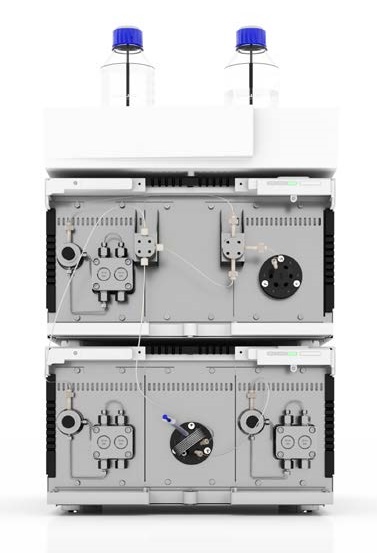
KNAUER's new benchtop IJM NanoScaler system is designed for lab-scale lipid nanoparticle formu-lation – allowing scientists to screen for optimal process parameters to formulate API-containing lipid nanoparticles.
The IJM NanoScaler is made for research and development as well as preclinical and smallscale production of lipid nanoparticles. Equipped with our lipid nanoparticle producing Impingement Jets Mixing (IJM) technology the NanoScaler allows researchers to optimize encapsulation conditions for their APIbased therapy before scaling up the process to run on a larger IJM NanoProducer unit.
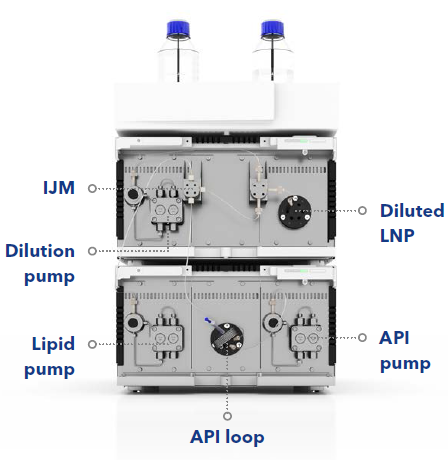
The NanoScaler is made for low sample consumption so as not to waste valuable API. Its small footprint means it can comfortably sit on the benchtop of a research and development lab. The system comes with five different KNAUER Impingement Jets Mixers to help researchers determine which conditions result in the optimum level of API encapsulation. These active pharmaceutical ingredients include complex or delicate API like RNA, mRNA, siRNA, and DNAbased molecules, or products that need specific entry into target cells. In addition researchers can use their own custom mixing unit and benefit from the flexibility of the system setup. The formulation process can be remotely controlled by software; ran from a conventional PC or laptop, or even a tablet.
Key parameters
PDI: between 0.1 and 0.2
Particle size:80–90 nm
Encapsulation Efficiency > 90 %
LNP FORMULATIONS FOR PRE-CLINICAL RESEARCH AND PRODUCTION
The NanoScaler can be used to produce lipidencapsulated nucleotides at a range from 1 ml to hundreds of milliliters meaning the system is perfect for:
Proof of concept testing and process optimization – pure nucleotides are an expensive resource. Carry out proof of concept testing and process optimization at the 1,000 μl scale to avoid wastage.
Pre-clinical trials – Preclinical testing can be carried out using 100 ml of nucleotides such as, for in vitro studies to determine the tolerability, efficacy and potential toxicity of the mRNA therapy of interest.
Small scale production – Once proofofconcept and safety testing have been successfully conducted, production of LNP encapsulated API´s can even be carried out at up to 0.1 Liter per minute with the IJM NanoScaler or using KNAUER’s scaledup IJMNanoProducer Units.
Which formulation parameters can be tested using the NanoScaler?
The IJM NanoScaler enables the scouting of several key process parameters during the lipid nanoparticle encapsulation stage.
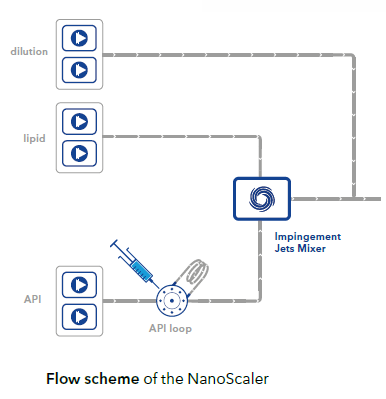
Mixing unit – The five different Impingement Jets Mixer geometries, plus the opportunity to integrate a custom mixing unit, allow determination of the process conditions required to achieve maximum efficiency, optimal particle size and homogeneous size distribution.
Mixing flow rate and ratio – Determine how the specific physicochemical properties of the lipid nanoparticle are impacted by the mixing flow – find out which flow rates and ratio provide optimum lipid nanoparticle encapsulation.
Lipid formulation – Testing of new lipid formulations, for example lipids with embedded antibodies for targeted medicines, is possible using the NanoScaler. Determine the conditions required to ensure lipid nanoparticle encapsulation takes place before producing the therapy at scale for trials.
Dilution protocols – The liquid flow path of the NanoScaler can be configured to either include or bypass the dilution step following lipid nanoparticle formation – allowing scientists to produce formulations at the exact concentration required.
Number of impingement jets mixers: 5, IJM 15 manual selection
Number of pumps:3
Number of flow meters:on request
Number of valves:2
Process connection inlet**:1/8" OD, 2.1 mm ID FEP tubing (UNF 1/428 thread, flat bottom)
Process connection outlet**:1/16" OD, 0.5 mm ID PEEK tubing (UNF 1032, thread coned)
Volumetric flow rate:up to 0.1 l/min
Volumetric flow rate:up to 6 l/h
Maximum operating pressure***:140 bar (2030 psi)
Liquid temperature range:4–60 °C (39.2–140 °F)
Wetted materials:stainless steel, PEEK, titanium, FFKM, PTFE (GFP 55), aluminum oxide, ruby, sapphire, ETFE, PETP, zirconium oxide, Hastelloy, FEP
Software:CDS optional available 21 CFR part 11 and Gamp 5 compliant
Interfaces:LAN, pin header connectors
Power supply:docking station (including pumps and valves): 100–240 VAC single phase, 50/60 Hz; PC: 100–240 VAC single phase, 50/60 Hz; Monitor: 100–240 VAC single phase, 50/60 Hz; Network switch: 100240 VAC single phase, 50/60 Hz, 12V DC Power supply
Power consumption (per device):docking station (including pumps and valves): maximum 130 W; PC: 1000 W; monitor: 380 W; network switch: 50 W
Ambient conditions:temperature range: 4–40 °C; 39.2−104 °F; below 90 % humidity (noncondensing)
Dimensions (W x H x D):361 x 501 x 603 mm
Net weight (approx.):35 kg
API-predilution and quenching:only quenching
Customized technical documentation, order-and article-related:on request
Factory acceptance test:on request
Site acceptance test:on request

Microfluidizer Nanotechnology Limited, Company number: 13114417
| 
|


