


Tel:742-138-8342
Email:uksales@anson-mpe.com

Mild Dispersing
Mild Dispersing
Our Original “Mild Dispersing” Technology
That Suppresses Damage to Particles
To grind and/or disperse particles down to nano size, suppressing damage to particles is a crucial factor.
Mild dispersing, our original technology, enables dispersion while maintaining the size, shape, crystal structure, and surface conditions of primary particles, as well as preventing re-agglomeration by minimizing the impact on particles and surface activation.
After Conventional Dispersing
Due to excessive dispersing, particles are susceptible to damage, resulting in re-agglomeration.
Particle properties are also susceptible to damage.
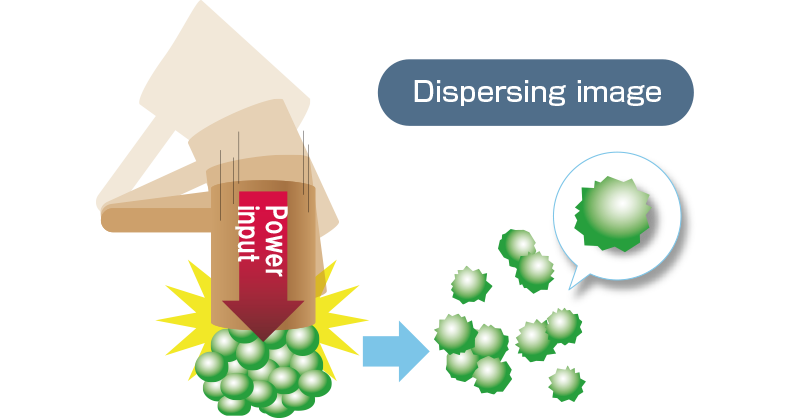
Mild Dispersing
Mild dispersing enables production of high quality and high-precision fine particles without excessive dispersing and damage.
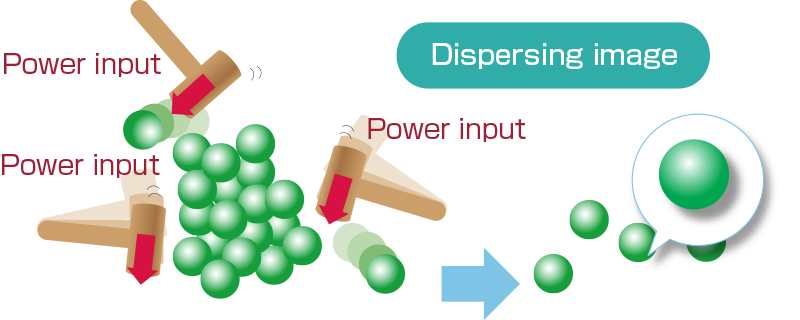
Advantages of Mild Dispersing
Maintained particle properties
No re-agglomeration
Reduce additives amount
Example of Mild Dispersing
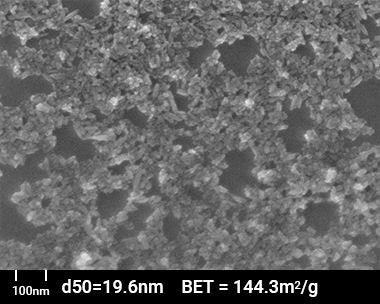
Mild dispersing : Dispersing while maintaining the needle-like shape.
Case Example of TiO2
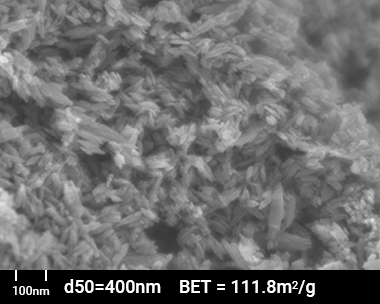
Raw material
After conventional dispersing

After mild dispersing
Ideal Beads’ Movement
”Spiral Laminar Flow“
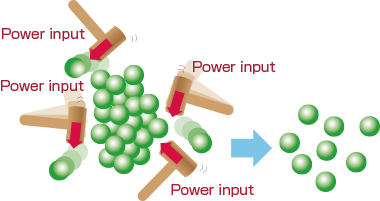
Dispersing image

Bead movement
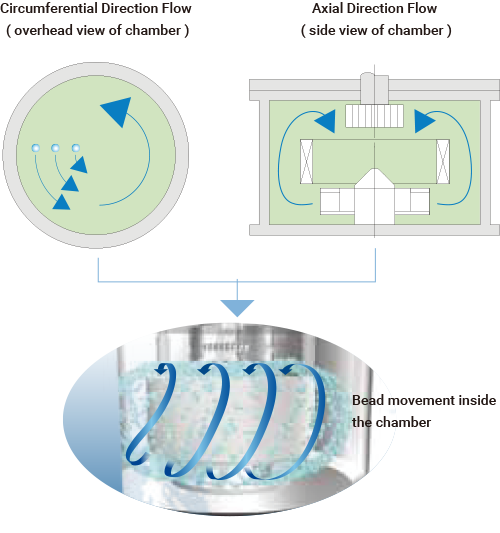
Bead movement inside he grinding chamber

MAX NANO GETTER
Features of the MAX NANO GETTER HFM
The special agitator and rectification member form a spiral laminar flow, resulting in no dead space or congested points inside the grinding chamber. With this feature, beads are uniformly distributed, applying proper energy to particles and enabling effective dispersion.
Moreover, the MAX NANO GETTER HFM is a bead mill structured with a stirrer mechanism that facilitates self-dispersion by causing shear force and friction between particles in the slurry flow.
Points to Consider When Operating Conventional
Bead Mills While Suppressing Damage
1. Stable use of microbeads
In general, beads with a diameter of 0.03 mm to 2.0 mm are used in bead mills. However, when employing the mild dispersing of nano particles, use minute beads with tens to one hundred micrometers.
By using minute beads, more beads can be present per unit volume, increasing the probability of contact between particles and beads.
In addition, as the mass per bead falls, particles can be dispersed without damage.
2. Reduction of the bead filling ratio
In combination with the use of minute beads, reduce the amount of beads to fill relative to the grinding chamber volume. However, while damage to particles can be suppressed by reducing the bead filling ratio, this may affect grinding efficiency.
3. Reduction of the agitator's circumferential speed
Reduce the circumferential speed of the agitator. However, while damage to particles can be suppressed by reducing the circumferential speed, this may require longer grinding time.
As described above, damage to particles can be reduced by operating machines under conditions 1 to 3. However, the use of minute beads may affect operability, and the reduction of the agitator’s circumferential speed and bead filling ratio may decrease efficiency.
To solve these issues, the NANO GETTER series has been developed and it enables “ideal mild dispersing.”
Microfluidizer Nanotechnology Limited, Company number: 13114417
| 
|


